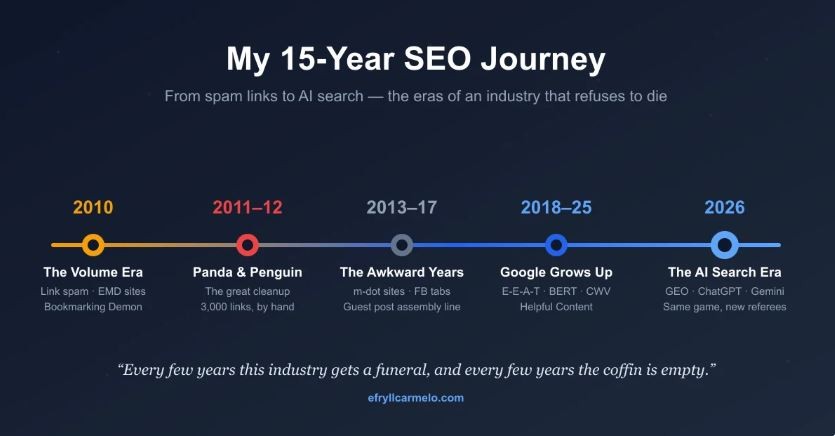
ILOILO CITY, Philippines — Efryll Carmelo, a senior SEO manager who has worked with clients in the United States, Canada, and Australia since 2010, published a retrospective on his 15-year journey in search marketing, documenting how the industry survived algorithm updates and why he believes AI search marks a new beginning rather than an end.
In the piece, Carmelo revisits the early days of SEO, when rankings were driven by volume. He recalls using automated software such as Bookmarking Demon to submit sites to hundreds of social bookmarking directories overnight and Market Samurai to surface low-competition keywords. He also describes building micro-niche websites on exact-match domains with thin content and Google ads, each earning $20 to $50 a month.
The turning point came with Google's Panda and Penguin updates in 2011 and 2012, which targeted thin content and manipulative links. Carmelo notes that the disavow tool did not yet exist, forcing manual cleanup. "Imagine one website with three thousand backlinks that now had to come down," he said. "We emailed webmasters one by one asking them to remove links we had spent years building."
The industry adapted again with Google's 2018 Medic update, the 2019 BERT model, the 2022 Helpful Content update, and subsequent spam policies. Now, search behavior is shifting with AI Overviews appearing in roughly 25% of Google searches, and 58.5% of U.S. searches ending without a click. Carmelo highlights the rise of generative engine optimization, where practitioners earn citations in AI-generated answers.
Carmelo argues that the current moment favors newcomers. "In 2010 the barrier to entry was owning spam software. In 2026 it is curiosity," he said. "Anyone thinking about entering this profession should be running toward it, not away from it." He emphasizes that survival in SEO requires patience and a genuine love for the game, as results are earned over months and the rules constantly change.