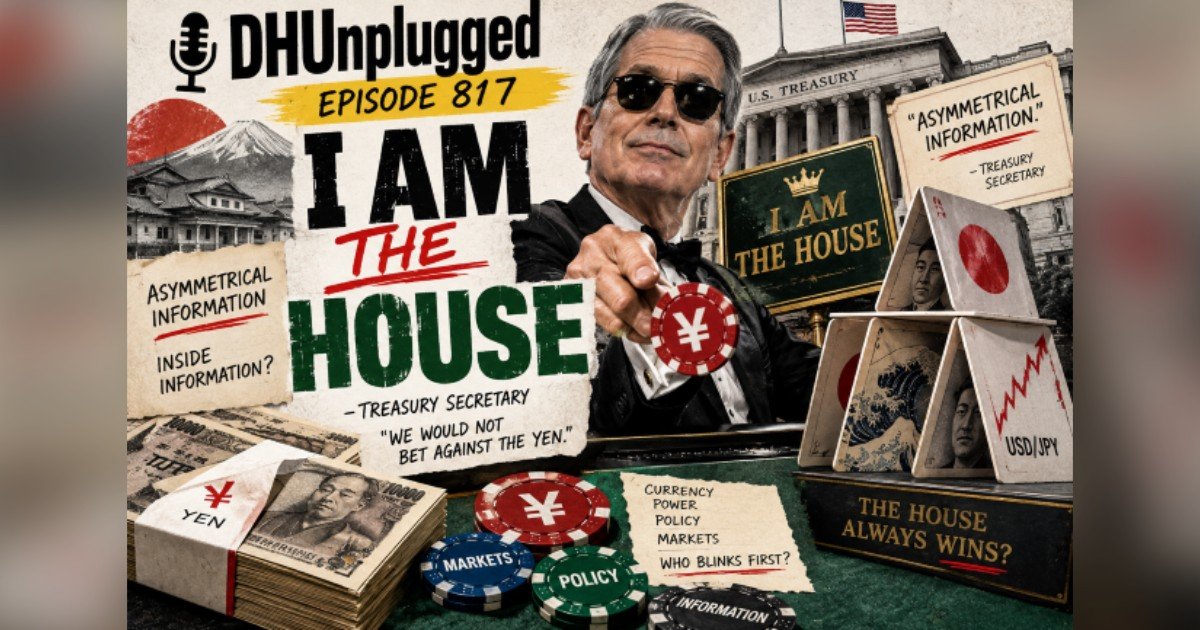
The post-Labor Day selloff deepened this week as the Dow Jones Industrial Average fell more than 600 points, with investors grappling with rising bond yields, an oil price shock, and a controversial comment from Treasury Secretary Scott Bessent. On the latest episode of DH Unplugged, hosts Andrew Horowitz and JC Dvorak dissected Bessent's declaration that he holds inside information on the Japanese yen, framing it as a watershed moment that reveals how policymakers now operate as 'the house' in financial markets.
Bessent's remark, made amid market turbulence, suggested that his statements on currency matters carry absolute weight because he has access to non-public information about Japan's economic moves. Horowitz highlighted the significance, saying, 'His way of putting this is, I have an edge. And he even said, because I have the information, I have the inside information about what Japan is doing, therefore when I say something, it's not going to be speculative. It's going to be absolute.' Dvorak placed the comment in historical context, arguing that since 2008 the government has increasingly behaved like the Roman Senate before Caesar, with the Trump era making the dynamic impossible to ignore.
The episode, titled 'I Am the House,' arrives as markets brace for Friday's Consumer Price Index (CPI) report, which many strategists view as the ultimate credibility test for the Federal Reserve. With inflation expectations drifting and the Fed's policy path uncertain, the CPI print could set the tone for risk assets into year-end. The hosts also noted the quiet on AIS trackers in the Strait of Hormuz, a development that contrasts with Goldman Sachs' $120 per barrel oil target, suggesting potential supply disruptions that could further complicate the inflation outlook.
Bond yields have been climbing despite a robust economy, with 10-year and 30-year Treasury yields rising against a backdrop of over $40 trillion in national debt. Horowitz explained that his firm is buying only short-duration Treasuries, citing the crush of new issuance from Washington and from data center operators tapping capital markets globally. This dynamic is also influencing equity markets, as seen in Bloom Energy's addition to the S&P 500, which sparked sympathy rallies in Oklo and other small modular reactor stocks, along with strength in Intel, AMD, and SK Hynix ahead of Broadcom earnings.
The episode touched on a range of other consequential stories, including Meta's roughly $18 billion multi-state settlement over youth safety guardrails, NVIDIA's reported $13 billion acquisition of Hugging Face—which JC called a week early—Shein's downsized Hong Kong IPO, Good Good Golf's Callaway ad backlash, Nike's exit from the S&P 500, Argentina beef imports, a 162,000 payrolls print, and Astra's partial Navier-Stokes proof.
Horowitz and Dvorak's skeptical, unfiltered tone underscores a growing concern that the line between policymaking and market manipulation is blurring. Bessent's 'I am the house' comment is not just a boast but a signal that the rules of the game have changed, with profound implications for investors navigating a landscape where central banks and treasuries are active participants rather than neutral referees.