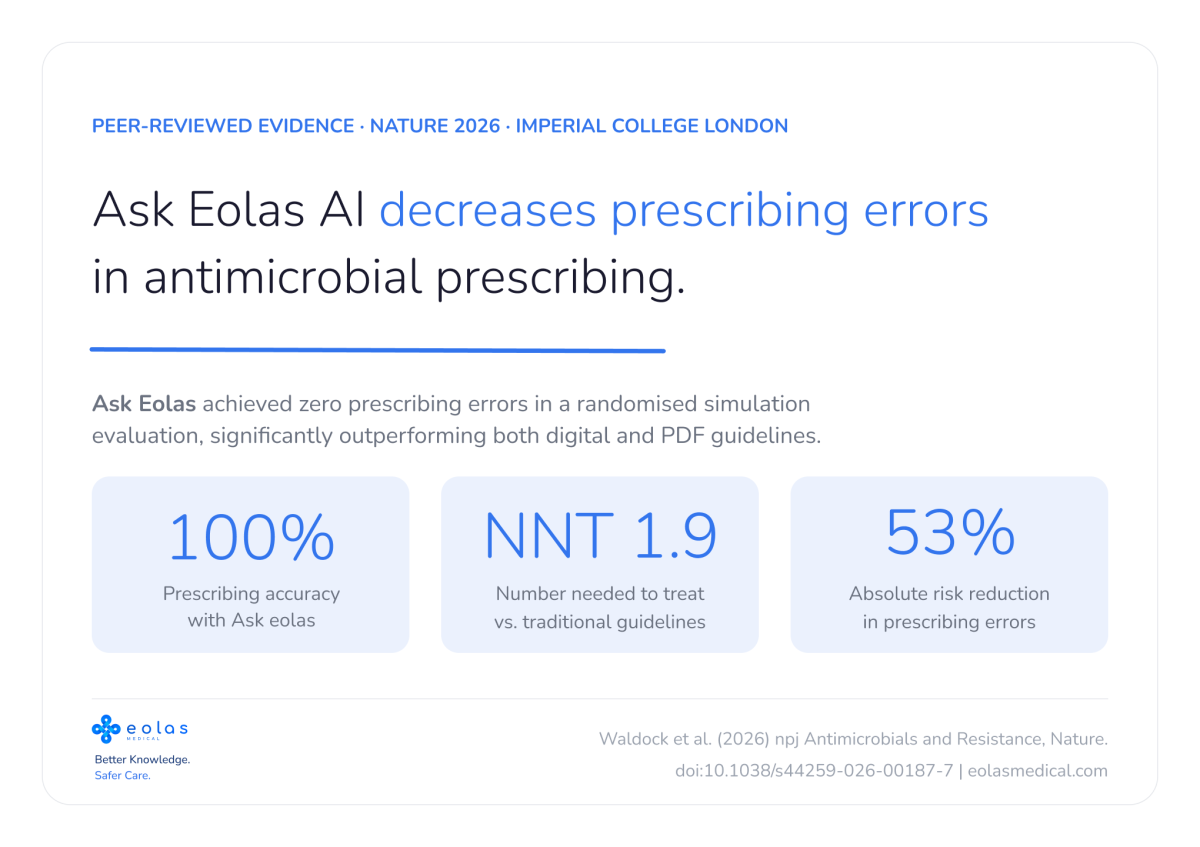
A groundbreaking study published in npj Antimicrobials and Resistance has demonstrated that Ask Eolas, an AI-powered clinical decision support system developed by Eolas Medical, achieved 100% prescribing accuracy in a randomized controlled trial. Conducted by researchers at Imperial College London with support from the NIHR Northwest London Patient Safety Research Collaboration, the study highlights a potential solution to the escalating U.S. antibiotic crisis.
American hospitals face mounting pressure to reduce inappropriate antibiotic use under stewardship mandates from The Joint Commission, CMS, and the CDC’s National Action Plan for Combating Antibiotic-Resistant Bacteria. According to the CDC, up to 50% of antibiotics prescribed in U.S. hospitals are unnecessary or inappropriately prescribed, contributing to more than 2.8 million antibiotic-resistant infections and over 35,000 deaths annually. The implications of this study are profound: if widely adopted, Ask Eolas could dramatically reduce these numbers.
The study evaluated three tools across progressively complex prescribing scenarios involving 45 clinicians: Hospital PDF Guidelines (47% accuracy), the Eolas App (60%), and Ask Eolas (100%). The improvement was statistically significant (p < 0.001). The absolute risk reduction was 53% compared to standard PDF guidelines, with a number needed to treat (NNT) of 1.9 — meaning for every two clinicians using Ask Eolas, one additional prescribing error was prevented. This level of precision is unprecedented in clinical decision support.
Beyond accuracy, clinicians using Ask Eolas reported substantially higher prescribing confidence and lower cognitive workload across all domains of the NASA Task Load Index, a standardized cognitive workload assessment. This suggests that the system not only improves outcomes but also enhances the clinician experience, potentially reducing burnout in high-pressure environments.
Ask Eolas operates by allowing clinicians to ask questions in natural language and receive answers drawn exclusively from their health system’s own approved guidelines and protocols, with full source references. This retrieval-augmented generation approach improves clinician access and adherence to hospital-developed protocols at the point of care, ensuring transparency and auditability. The technology is already deployed across several leading U.S. health systems and academic medical centers, including Mass General Brigham, Stanford, and Boston Children’s Hospital, and is expanding antimicrobial stewardship capabilities nationwide.
Eolas Medical recently opened its U.S. headquarters in Cambridge, Massachusetts, and continues to build out its team to expand its reach across the U.S. market. “This study demonstrates how guideline-grounded AI can strengthen antimicrobial stewardship infrastructure while supporting frontline clinicians in high-pressure environments. With the opening of our U.S. headquarters in Cambridge, Massachusetts, we are firmly committed to making this technology available to health systems across the country, because every clinician deserves real-time access to the best evidence at the point of care,” said Dr. Declan Kelly, Founder & CEO of Eolas Medical.
For more information, visit www.eolasmedical.com and read the full study here.